

The management of the Value Added Group division of Western Forest Products (Western) in Chemainus, B.C., are big fans of the team concept when tackling projects, most recently with new lumber drying equipment that will bring substantial improvements to the Vancouver Island operation.
Supported by funding from the B.C. government, the operation is now installing two four-zone Deltech Dual-Path Continuous Dry Kilns (CDK), which are being supplied and installed by B.C.-based equipment supplier, Comact.
And an additional specialized kiln will be installed later this year from Finnish manufacturer, Jartek Partners (see sidebar story).
The Comact kilns, one of which is now built and fully operating, are being used for “precision” drying, which will help Western expand its high-value applications for its wood products, such as materials for mass-timber projects.
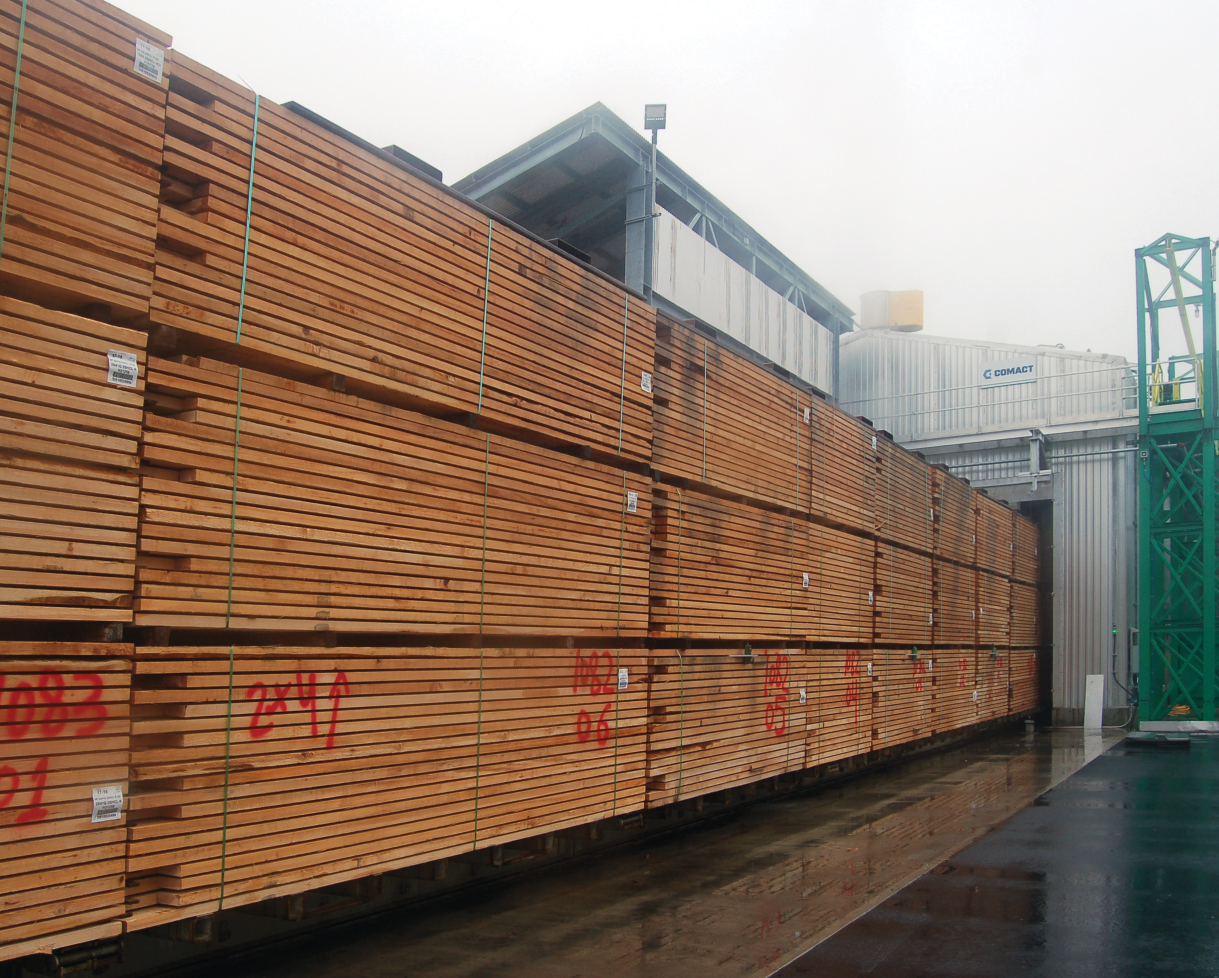
The first batches of lumber are now being loaded into one of two Deltech Dual-Path Continuous Dry Kilns scheduled for installation at the Value-Added Division in Chemainus.
The additional capacity will support increased volumes of all Western’s kiln-dried products, produced at the company’s five sawmills on Vancouver Island.
Investment in this long-term project is part of the company’s ongoing focus on higher value products and reflects Western’s significant investments in its B.C. Coastal manufacturing operations—modernizing primary facilities, increasing kiln drying and planing capacity and expanding its engineered wood products and remanufacturing capabilities.
The company installed a kiln from B.C. equipment company Wellons at its Saltair operation two years ago, which has been ticking along successfully, adding value at that operation.
Increased kiln drying capacity helps to ensure that Western’s products meet both internal value-added needs and customer expectations, and provides flexibility to respond to shifting market demands
The Chemainus Value Added Division is a remanufacturing operation that processes lumber from the sawmills owned and operated by Western. The facility includes a planer, a resaw and dry kilns to manufacture lumber into finished and unfinished products that are transported to customers or other facilities for further processing.
A. J. Gale, operations manager of the Value Added Division, noted that the operation has a great deal of experience to draw upon for the project, and a team approach worked well.
“We’ve got expertise within certain disciplines at Western and the operation, and that really fits well with the various components of the kilns project, and what we are, and will be, producing,” he says.
“These are the first Continuous Dry Kilns of their kind with Western,” he added.
The team includes company people with experience in quality control, project engineering and management, and, of course, kiln drying. “It was really not that long ago that we did the kiln install at Western’s Saltair operation,” he added, which is basically down the road from the Chemainus operation.
It’s been great to draw upon the people at Western for this project, and the Comact people, for the team, he says. At the core of the team for Western was Gale himself, Chris Walling (Supervisor, Kilns), Jamie Viala (Superintendent, Quality Control) and Jarrad Astren (Project Engineer, Capital Projects), along with fellow site leaders and maintenance personnel. Added to this have been the Comact people.
“This is a design/build project, with Comact’s project services team acting as the prime contractor, and they have been excellent,” says Gale. “From our perspective, with the team model, the working relationship with Comact has been seamless.”
Gale noted that the company’s Saltair kiln project went well, and three of the Western Chemainus team worked on that project, so they used a similar approach at Chemainus.
“The process itself remained pretty much the same, though our kilns at Chemainus have different capabilities,” he explained. “With Saltair, they put together an action list and they reviewed it on a regular basis. We saw that as a Best Practice, so we approached it the same way.”
They made some tweaks to the process, but Gale reports there was nothing major.
“It’s a similar concept but a different drying process than Saltair—we dry a different lumber mix at Chemainus. The kiln operations are tailored to different drying recipes that Comact has created with us.”
Comact, which is based in Prince George, B.C., manufactured the Deltech kiln components in Prince George, and has extremely strong capabilities at developing drying software.
“The program will let us know how fast it is going to push a load through the kiln based on moisture content and what the end use of the wood is going to be,” explains Gale.
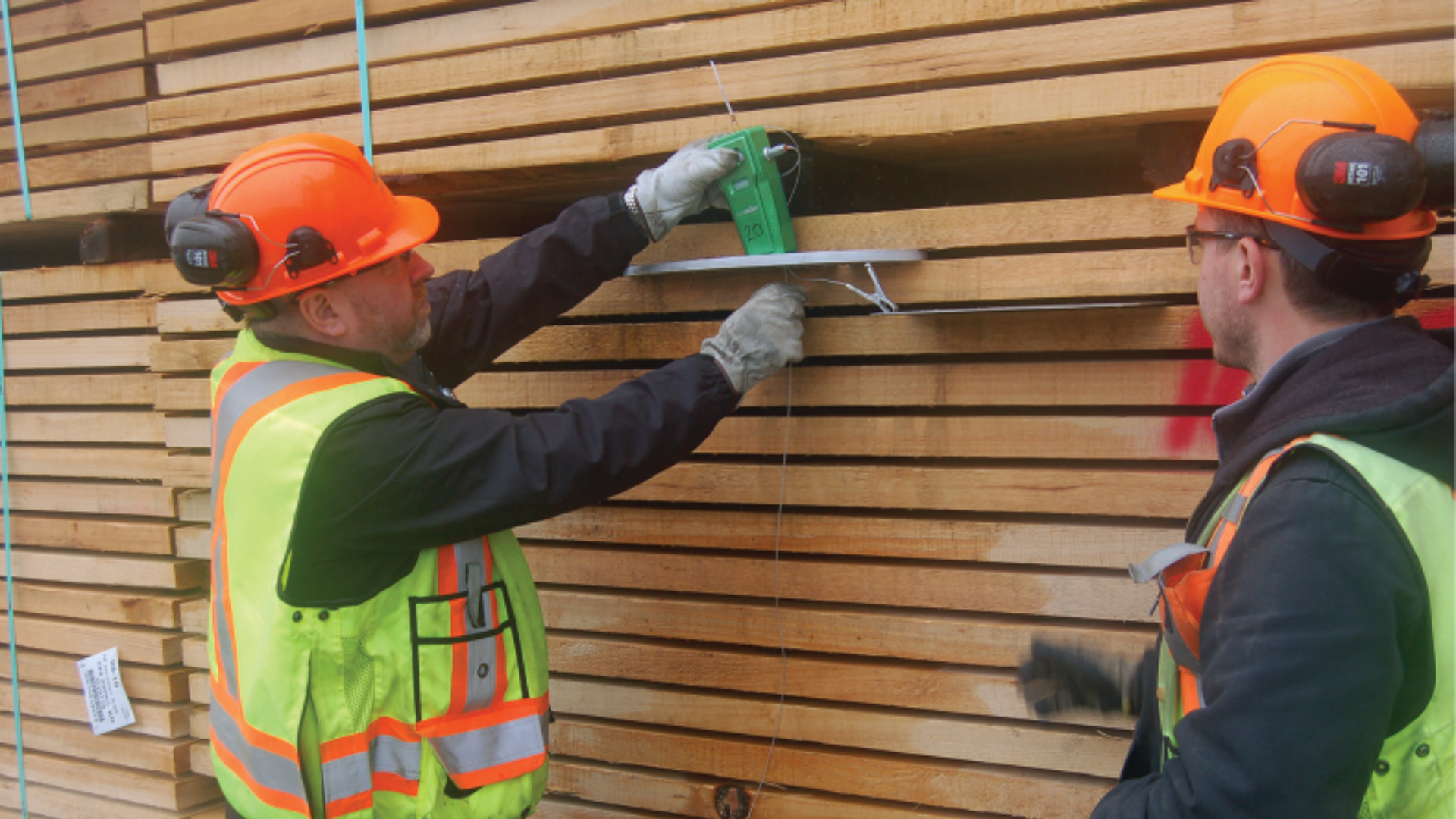
The monitors in the kiln control room display a dizzying amount of detail on each kiln load, including data from a series of KilnScout wireless moisture units throughout the kilns.
Gale noted that Comact was brought in early on the project. “Comact has been a leader in the kilns area and sawmilling equipment, and it was an easy option for us to go with them,” he says.
“The new four-zone system is unique to Comact, and it’s an opportunity for Western, and Comact, to do something different.”
Comact was there at the beginning, at the design phase. “They were coming to Chemainus when we only had bare land, before we had laid any foundations or had any early work done. They sized up everything, and did the design with our project team,” says Gale.
“The kilns are not commodity drying facilities,” Gale added. “The two kilns give us the added flexibility for the different products we are going to drive through them—we are going to have squares, boards, lam stock, a ton of different products going though the kilns, and the four-zone design enables that. The kilns are very capable of drying a very diverse range of products to a designed moisture content for us to take it for further processing.”
This, of course, fits extremely well with the overall Western corporate goal of adding value to its wood products, as did the Saltair kiln project. The company wants to get the absolute most value possible out of the production from its sawmills, and the high value wood products they are turning out. That is exactly what is required for forest companies such as Western to make Capital Expenditure commitments: these investments have to deliver increased returns, in higher value products.
“The returns have to be there, with these kind of projects,” says Gale. “ And so far, so good—the overall product quality that is coming out of the kiln is yielding the company a much better return.”
Comact brings a lot of experience to the table, and projects. “They basically looked at everything we were trying to accomplish, and said, ‘we can do it’.”
Gale said that more than a year out, Comact set a commissioning date of Feb. 20, 2026 for the first kiln—and they delivered bang-on, on that date. As with any kind of construction project, it’s only too easy to see some slippage in the start-up date.
One of the main features of the Western team was what they termed “field fit”. They would have regular meetings in the office, but then they would frequently just walk the site, to “field fit” various parts of the project—where does the traffic flow, where should trucks be offloaded, where does the dry shed go?
They’d actually be getting tape measures out to double check measurements of the designs on the computer.
Gale, who started out at Western’s Duke Point sawmill operation 10 years ago, noted that sawmill technology continues to progress, kilns included. “The technology is evolving so quickly,” he says.
The company has been working closely with Comact on the development of lumber moisture content and push rates, how quickly a wood pile proceeds through each 300-foot kiln. Each of the two kilns are actually 540 feet long, considering they have 120 feet of track on the infeed, and 120 feet of track on the outfeed.
“Some of these products have never gone through a Continuous Dry Kiln, and we are working with Comact to establish the push rates we want to set up for the different types and sizes of wood going through, what temperatures will get the desired results.”
Those push rates are evolving, he notes. They develop push rates based on experience and the characteristics of the wood, and trial them, and change them, as required.
“Similar products have gone through the Saltair kiln, too, so we started with a bit of a baseline based on some of their products.”
There has been a learning curve involved in developing the push rates, but it is a welcome one, because the end result will deliver the highest value products, with the lowest use of energy—truly a win-win, for Western, and its customers.
“We’re in the early phases of that, and we’re learning something valuable every day,” says Gale.
Like any forest industry operation, Western Forest Products knows what it is working with—the coastal mix of wood species—extremely well. But each stick, as the saying goes, can be different.
“Logs that we break down in our primary sawmill facilities could come from a different setting—higher elevation, lower elevation, second growth, mature stands, and varying sizes. There is going to be lumber that is more saturated with moisture than other lumber , so the wood produced is going to have different push rates.
“The B.C. coastal forest industry has a good handle on the wood we work with—we have to,” says Gale. “But its ever-changing. It’s not a one-size fits all—we have to adjust on the fly, as needed.”
Coastal B.C. wood is a high value resource, and Western is looking to make the most of it.
“The diversification of wood products is enabling us to be able to attract other markets, and that is going to be key for us, especially with what we are seeing in the industry right now, with certain markets doing ok, and other markets not doing so well.”
Such initiatives are going to help the coastal industry, which has been struggling in recent years, to remain sustainable.
While Comact designed and is building the kilns, they, and Western, see this as part of a longer-term partnership.
Comact, Gale notes, has a robust training and start-up plan that includes running various scenarios that Western staff might encounter, and how best to trouble-shoot them.
They are available on site now, and going forward, Comact will also be able to access the kiln system remotely, and help Western staff deal with any issues. “They want the kiln project to succeed and they want the customer, Western, to be happy,” he says.
And so far, so good, says Gale.
“We’re very encouraged by the initial performance, but we’re keeping the pedal to the metal—we’re not sitting back. We’re very focused on products going through the kiln and how they are reacting to the new process. We understand there is going to be a lot more for us to learn.
“We are not,” says Gale, “taking our foot off the gas.
_______________________________________________________________________________
Thermal modification kiln to come for Western
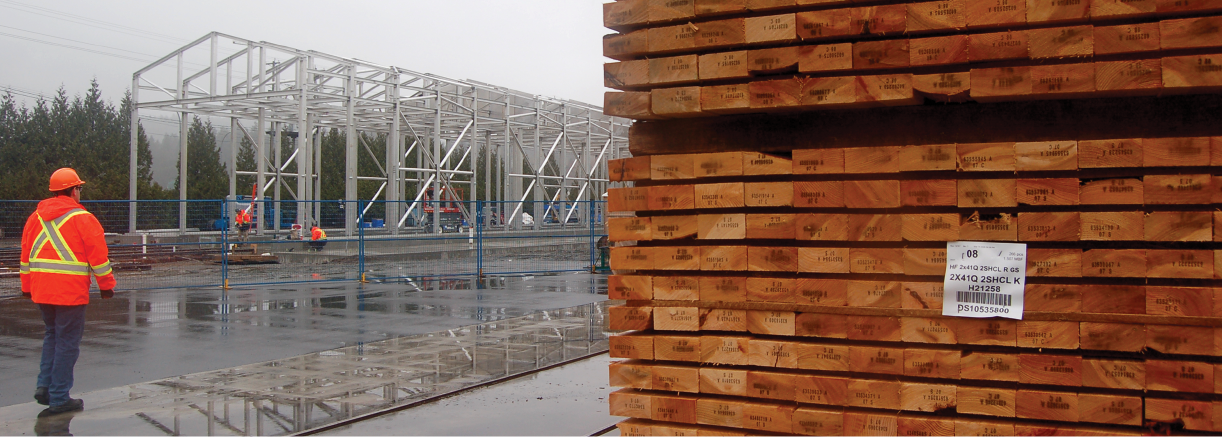
With construction of one Continuous Dry Kiln completed at Western Forest Products’ Chemainus Value Added Operation—and a second kiln under construction—the company will also be installing a third kiln later this year.
Western has signed an agreement with Finland’s Jartek Partners to supply a thermal modification kiln to the Value Added operation.
The kiln will support Western Forest Products’ plans to expand its thermally modified wood offering, with a strong focus on consistent product quality and efficient production. The solution delivered by Jartek is specifically designed to meet Western Forest Products’ production requirements.
Jartek’s established leadership in thermal modification and proven technology made it the clear choice, says Western.
Jeroen Hinnen, Sales Manager North America at Jartek, highlights the importance of the project for the company. “This project is particularly exciting for us at Jartek, as it represents one of our first thermal modification projects in this region,” says Hinnen. “Partnering with Western Forest Products allows us to demonstrate how our customizable technology can support local market needs and long-term production goals.”
Jartek’s thermal modification technology is designed to deliver flexibility, precise process control, and long-term reliability. This project reflects Jartek’s continued focus on providing customized solutions that meet the evolving needs of companies looking to enter or expand within the wood thermal modification market, says the company.
The initiative is part of Western’s broader five-year vision. The thermally modified wood product is intended to add value to lower-grade wood fiber within the company’s existing operations, and directly support a strategic goal of growing domestic demand for these specialty wood products.






0 Comments