


FORKS, Washington – Chad Dahlgren and his family have adapted over the years to the changing times, changing business climate. Now his company, Dahlgren Logging, is adapting to working on Washington’s rugged terrain with the addition of a Falcon winch assist.
The company put the Falcon winch assist into service earlier this year, and Dahlgren already is making plans to add a second one.
Dahlgren Logging is based in Forks, located in the northwest section of the Olympic Peninsula, only about 10 miles from the coast. “A lot of steep ground,” in the region, noted Dahlgren, 51.
The company, a member of the Washington Contract Loggers Association, was started by Dahlgren’s paternal grandfather, Joel, in 1966. The business began to grow when Dahlgren’s father, Pete, and Pete’s brother, John, joined after graduating from high school in the early 1970s.

From left, Chad Dahlgren and his sons: Luke (currently working in Alaska), Nate (now in the Air Force), and Jack, who helps Chad run Dahlgren Logging
By the mid-1980s Dahlgren Logging had over 80 employees and operated six or seven cable logging crews and a few shovel logging crews. Timber was becoming available in steeper country, said Dahlgren. “It was an opportunity to build a company, and that’s what they did.”
Following the collapse of the industry after the listing of the spotted owl as a threatened species in 1990 and the resulting logging restrictions on federal lands, the company eventually rebuilt back up to four cable logging crews.
Today Dahlgren Logging employs about 40 people. It runs two or three tower yarding crews and two shovel logging sides. The company is down to two shovel crews and two yarder crews because of market conditions and the difficulty of finding labor, said Dahlgren.
Dahlgren contracts to harvest timber for industrial forestry companies, such as Sierra Pacific Industries, Campbell Global, Alta Forest Products, Ecotrust Forest Management, and Bloedel Timberlands. The company mainly supplies mills for Sierra Pacific, Interfor, and Alta Forest Products at Port Angeles and Aberdeen.
Dahlgren Logging mainly works on state timber sales or private land, timber ranging from 40-80 years old. Most of the tracts are Douglas fir, Western hemlock, spruce, and some cedar and alder.
The Dahlgrens have favored Madill equipment over the years.The company has six yarders: five towers – two Madills and three Bergers – and a T-Mar Industries swing yarder. The yarding crews Boman Industries carriages as well as a Falcon grapple carriage and two Summit Attachments grapple carriages. For processing the company is equipped with seven Madill 3800 swing machines, each paired with a Waratah head. Loading is done with six Madill 3800 loaders. The company also has two Cat 548 forest machines, a Cat 568 forest machine and a Tigercat 870 loader.
LOGGER’S TIP: “We have to figure out the way to get the next generation of loggers. We’re behind compared to other industries. We have to find the means to recruit the next generation of employees and compete on the job market. I think it has to be higher wages and benefits.” – Chad Dahlgren
“We have gone from having the biggest yarder ever built for logging old growth to now running one Berger M2 tower yarder with a couple of Madill 172 towers or swing yarders,” said Dahlgren. “We still use the Bergers for the bigger, long yarding units and still hang out 5,000 feet or better.”
Dahlgren generally relies on other contractors for felling. One contractor with a Tigercat LX877 feller buncher typically is used where a shovel logging crew can work, and the buncher and other machines can be tethered as needed. On steeper terrain where cable logging crews work, another contractor fells timber by hand.
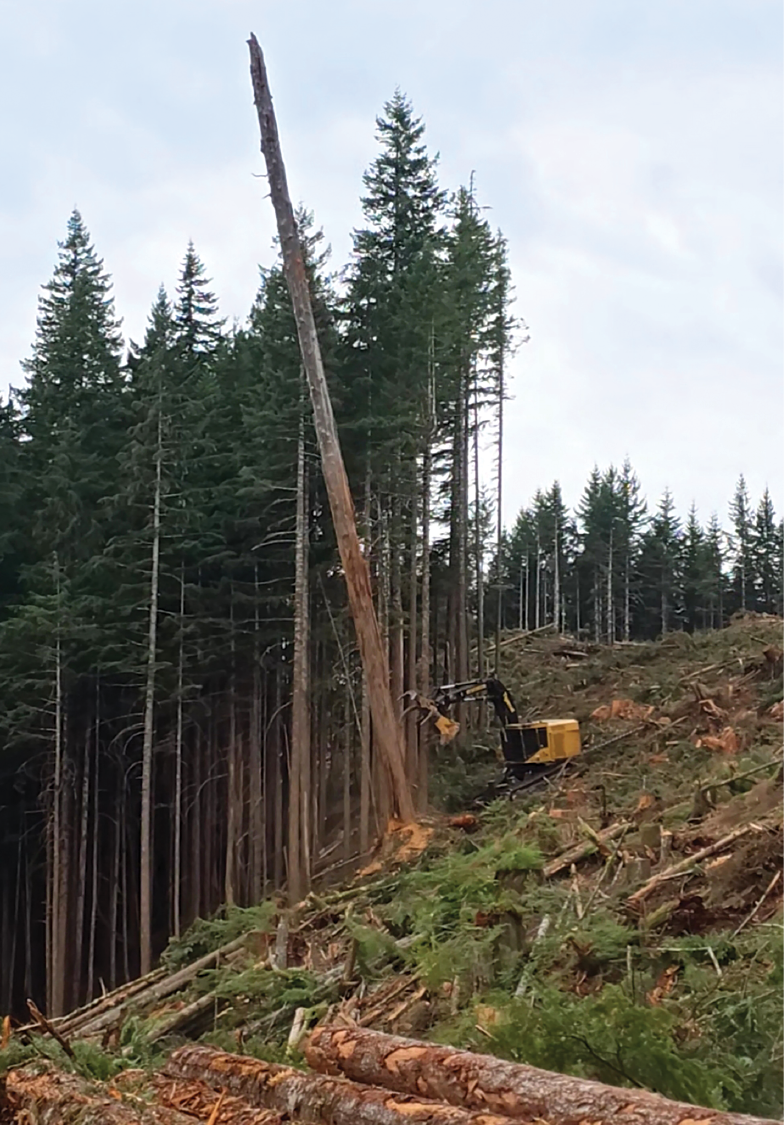
Tethered Tigercat feller buncher works on steep ground.
The most recent investments in machinery are the Falcon winch assist system, which was mounted on the Cat 548 forest machine, and a Tigercat LS857 shovel logger. Dahlgren added the equipment “to have a fully mechanized yarder side to boost production on a smaller tree farm.”
The Falcon winch assist can be mounted on all major brands of base machines. The base machine must weigh at least 30 tons and have a minimum hydraulic oil flow of 105 gallons/minute. The Falcon winch assist uses 1-⅛-inch cable. The maximum operating angle is 45 degrees or 100 percent from the top to the bottom of the slope.
The Falcon system has minimal impact on the original specifications and performance of the base excavator, so it can be used as an all-purpose machine for other tasks. It comes with the option of a quick hitch so it can also operate as a loader, conventional excavator, or as a loader or shovelling machine.
The Falcon winch assist is engineered to be uncomplicated, simple to operate, and easy to maintain. The operator of the tethered machine has only one cable to manage when maneuvering down the slope. The design features less mechanical and electrical complexity – and therefore less opportunity for faults and breakdowns. The winch unit is enclosed by rear guarding for protection with easy access points for maintenance.
The Falcon winch assist has numerous safety features to eliminate operator risk. For example, an overspeed alarm triggers a rope management system that automatically tensions the cable to reduce the speed of the tethered machine – and notifies the operator to slow down. Another alarm alerts the operator if the winch-assist machine experiences any movement. There are additional safety features.
The Falcon system was put into service in the spring. “We really like it. It’s working good.” In fact, Dahlgren bought another used Cat 548 forestry machine and plans to add a second Falcon winch assist.
The Cat forestry machine is a multi-purpose machine that can be configured as a loader or for other logging tasks, such as processing. “We kind of decided we wanted the winch assist on a loader for more versatility,” said Dahlgren. “We can use the grapple to clean up, and it’s a little easier to get around than an excavator.”

Falcon winch assist has minimal impact on the original specifications and performance of the base excavator, so it can be used as an all-purpose machine for other tasks.
“The Falcon winch assist and the Tigercat have been working great for cutting steep ground and feeding wood to the lines,” said Dahlgren. The winch assist has been used alternately to tether a feller buncher or the Tigercat, which shovels logs into position to be yarded.
Dahlgren considered other suppliers of winch systems and looked at a few of their videos. He was attracted to Falcon in part because they “seem to have a pretty good reputation.” He purchased the Falcon system from Modern Machinery, dealing with Russ Smith; Dahlgren was acquainted with Smith and had done business with him for years. “Dan Butler and Hayden Thorn from DC Equipment (manufacturers of Falcon) were great to work with getting it set up.”
Dahlgren referred to the Tigercat LS857 as a “tilter loader.” Equipped with Tigercat’s patented super-duty leveling undercarriage, the machine bridges the gap between conventional ground-based logging and yarding operations, according to Tigercat. It can be equipped with a variety of grapple styles or the Tigercat 5195 directional felling saw for felling and shovel logging with a single machine. The Tigercat LS857 features a sloped tail for enhanced leveling capability; the unique tail increases leveling capability to 26 degrees forward while providing clearance for the tracks and winch-assist chains.
When he talked with TimberWest, the five crews were working on four jobs – one large job of 150 acres had a yarder crew and a shovel crew. Normally each crew works on a separate job. “It depends on the size of the job and the timing,” said Dahlgren. The Falcon winch assist was being used to tether another contractor’s feller buncher to harvest trees on a tower yarding job – an 80-year-old stand on steep private land. Slash normally is piled on a job and burned in the fall.
Dahlgren Logging has six log trucks and also relies on Worley Trucking for hauling wood. Average haul distance ranges from about 75-200 miles.
Fuel prices seem to be “constantly going up,” noted Dahlgren. Highway diesel fuel was at $5.29 when he spoke with TimberWest, and off-road diesel was above $4.
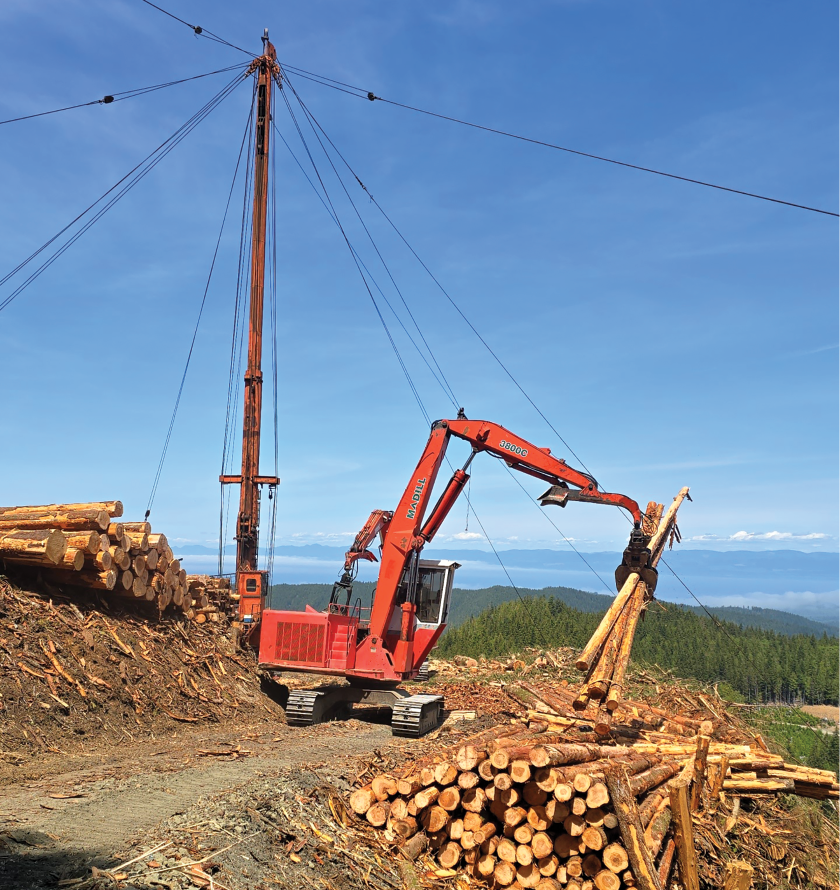
Madill loader working at a landing.
The company has been on quotas lately because of market conditions. “They’re having trouble getting rid of their lumber,” observed Dahlgren. In order to adapt, his employees are working 8-hour days instead of 9 or 10.
“We’re kind of the last ones out here with a big tower,” said Dahlgren, who enjoys hunting and fishing in his free time. “We’re a generational company.”
He is the third generation. All three of his sons have worked in the business. Oldest son, Jack, is his “right hand.” Dahlgren and Jack oversee the cable logging operations, lay out jobs for cutting, and decide on road changes. Dahlgren also looks at timber sales and prepares bids. Another son, Luke, was scheduled to return to the company in the near future.
Dahlgren’s father, Pete, 73, is semi-retired. However, most days he still comes to the company’s shop. He also helps by picking up or delivering parts, driving pilot cars, and other tasks. And he weighs in on strategic decisions – like the investment in the Falcon winch assist. “His guidance and involvement are invaluable to the business,” said Dahlgren
Dahlgren has other family in the business, too. His mother, Cheri, used to run the office; she is semi-retired and continues to fill in. She plays a vital role in the company’s decision making and office management. His wife, Shannon, and aunt, Jo Marie Miller, run the office now; his brother-in-law, Pat Graham, works in the company, and his father’s cousin, Dave Larsen, runs the saw shop.
TimberWest Magazine — November/December 2025 — www.forestnet.com






0 Comments