

DEARY, Idaho – Justin Everhart and his company, JEM Forestry, have earned a reputation for taking on the “worst of the worst” in terms of site conditions. “We’ve gotten good at working on the steepest, wettest, slipperiest sites,” said Everhart.
JEM Forestry is based in Deary in northwest Idaho, a little more than 20 miles east of Moscow, which sits right next to Washington. Everhart and his company work almost exclusively with PotlachDeltic, which merged with Rayonier at the end of January.
Rayonier operates mills in Idaho, the Great Lakes, and the South. It has about 1.2 billion board feet of lumber capacity and produces a wide array of lumber products and plywood. The company owns 931,000 acres of timberland in Idaho, Oregon and Washington and another 3.2 million acres in the South, primarily Texas and the Southeast.
JEM Forestry supplies wood to mills in Saint Maries that manufactures lumber and plywood. Working land owned by Rayonier, JEM primarily harvests grand and Douglas fir and some cedar.
Everhart, 33, enjoys working for them because “they treat me like a person, not a number,” and the work is steady. Rayonier provides road maintenance and slash clean-up; it replants every site with a harvest life cycle of 55-60 years.
The company is paid by the ton. Prices could be better, but mills have been “plugged full” with wood, he noted. “With the market the way it is, I’d say it’s fair.” Trucking rates, however, “definitely need help.”
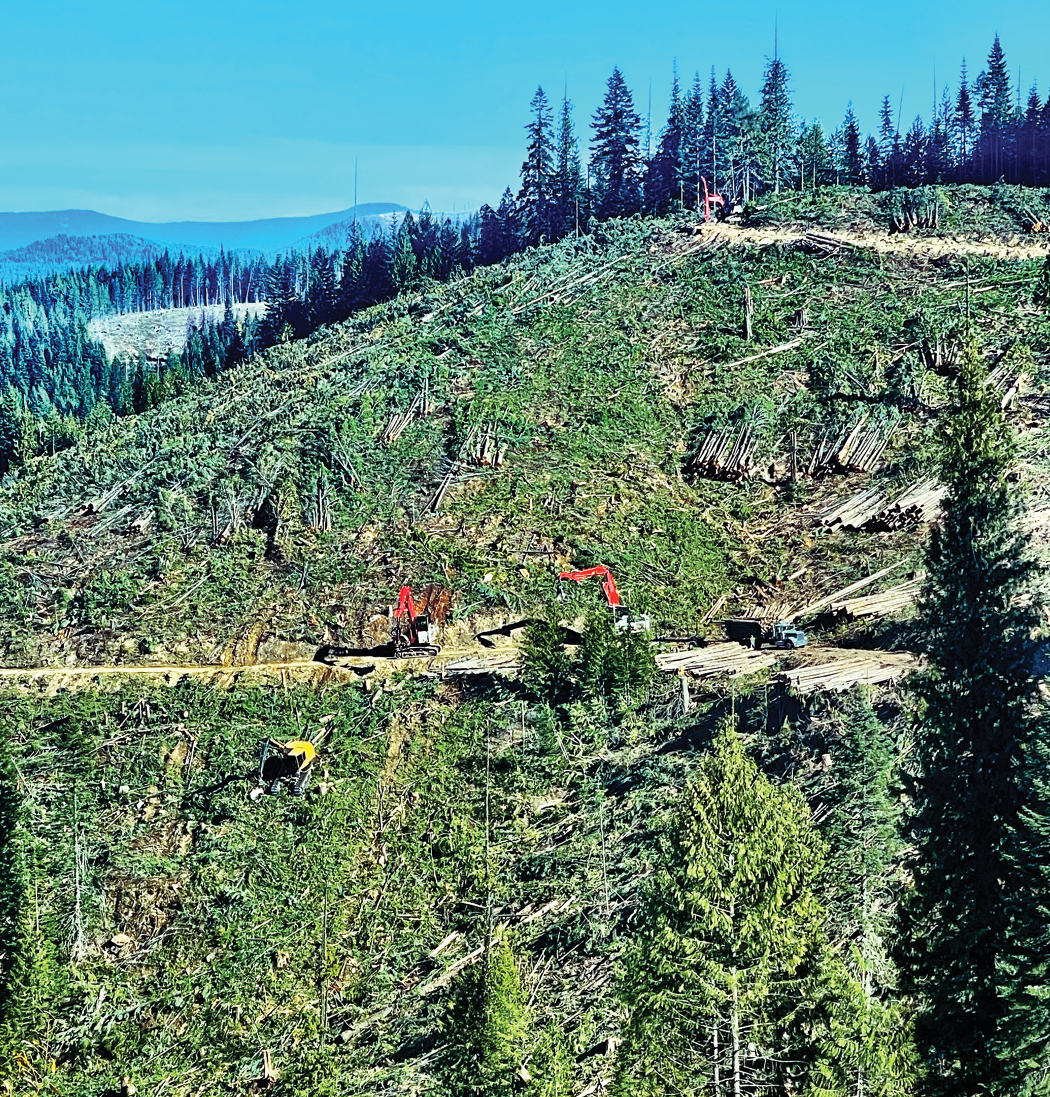
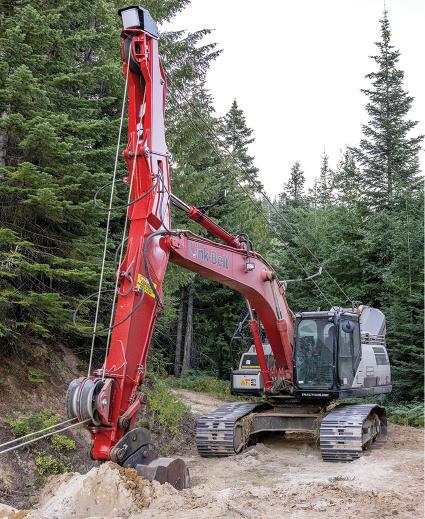
Tractionline winch assist system, shown in inset and shown above stationed at top of summit, is mounted on a Link-Belt 300. The Tractionline system uses two cables to tether a machine.
JEM Forestry does considerable work on steep terrain and shovel logging. However, the clay soil in Idaho makes these sites particularly challenging as mud often builds up on equipment tracks and tires. The company relies on a fleet of versatile equipment to work in the wet, slippery conditions.
A forester once told Everhart, “When you get good at cleaning toilets, you clean toilets.” Everhart took that to mean, “Do what you’re good at.” For JEM, that’s often the more challenging logging jobs.
With five employees, including himself, Everhart runs a single crew six to seven days a week. They work in an area spanning from Clarkia, about 160 miles north, to Elk River, less than 30 miles east. Average travel time from Deary is about one and a half hours.
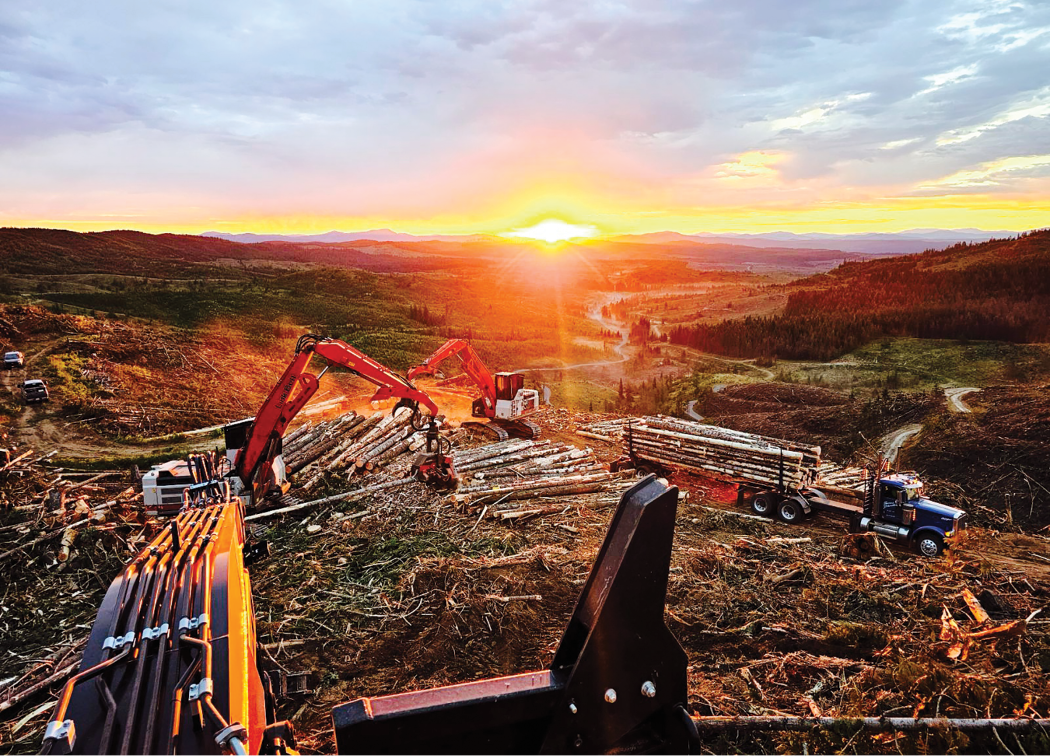
Processing timber and loading a truck at a landing. JEM Forestry works almost exclusively for PotlachDeltic, which merged with Rayonier.
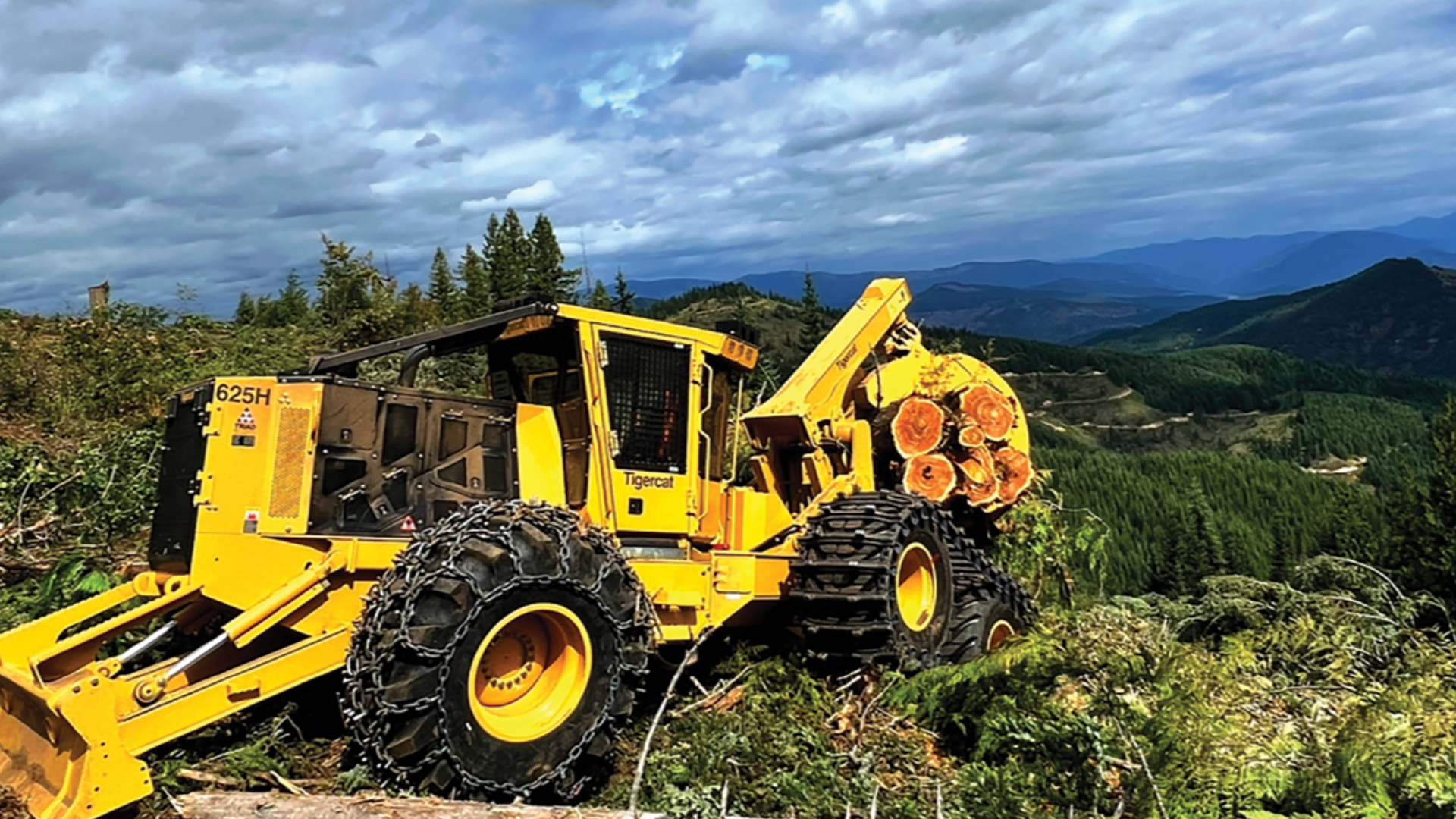
Everhart has been performing mechanized logging since 2020 and has found success using several Tigercat machines. He calls himself a “diehard Tigercat fan.” He currently owns three Tigercat machines: an 830E feller buncher, an LS855E shovel logger with a felling head, and a 625H skidder.
JEM Forestry also is equipped with two LinkBelt 4040s shovels, one with a Waratah 623 processor head; a LinkBelt 300 with a Tractionline winch assist system; a LinkBelt 200; a CAT 568 forestry machine and a CAT 160H grader; and a Komatsu 65 bulldozer. Everhart prefers to run newer equipment as it reduces shop time and maintenance costs.
He invested in the Tractionline winch system a few years ago because most of the relatively flat or gently sloping ground has been cut. He likes the fact that the Tractionline uses two cables to tether a machine. It is used to tether the Tigercat 830 or Tigercat LS855E as well as the Cat 568 shovel.
His most recent investment in equipment was the Tigerercat 625H skidder, which he purchased from Triad Machinery in the fall of 2024. It has an extreme duty rear bogie axle and six-wheel drive to provide improved traction in the worst conditions. He especially likes the six-wheel design, which is good on both steep slopes and soft ground conditions. The Tigercat 625H has effectively added a month and a half to JEM’s logging season compared with traditional four-wheel skidders.
Additionally, it has enabled JEM to take on jobs it would otherwise have had to pass up due to a lack of the right equipment. They can now take on steep slope jobs even during the wet months. With the extended season and additional work, the skidder has been a worthwhile investment that will pay for itself multiple times over, according to Everhart.
LOGGER’S TIP
“The best advice I can give is save every penny
you can when the going is good because it will
turn bad, and you can get through it.”Justin Everhart, JEM Forestry
He based his decision to purchase the Tigercat 625H skidder on the experience of other loggers. Tigercat equipment is “built heavier and of higher quality,” said Everhart, “and it outlasts the competition.”
When he talked with TimberWest the Tigercat 625H skidder was working on a site with a slope ranging from 30-60 percent, skidding grand and Douglas fir and cedar logs. On the steeper terrain, JEM is using a shovel logger. Trucking is subcontracted with six to eight trucks departing the site each day.
Everhart’s first mechanized logging machine was a Tigercat LX830D feller-buncher, which he bought in 2020. He has since upgraded to a Tigercat LX830E. The LX830E has long track frames, a wide carbody, durable leveling components, and unique geometry that improves its stability on sleep ground. A winch assist system is used to further enhance their capabilities when working on steep, slippery terrain.
The Tigercat LS855E shovel logger is designed to fell, bunch and shovel timber in challenging conditions. The LS version is equipped with Tigercat’s extreme duty leveling system, which features long frames and wide stance for excellent stability. It can be equipped with either a live heel (and grapple) or feller director (and Tigercat 5195 directional felling head) boom options; the feller director configuration allows the machine to fell and extract independently or fell and bunch for a skidder or yarder. It is available with several engine choices, including the Tigercat FPT N67 Tier 4f, which generates 284 hp.
Everhart is the fourth generation in his family to work in logging. He grew up in Bonner’s Ferry, where his great-grandfather started Everhart Logging, which was passed down to his grandfather and father. Everhart began working in the company as a teenager.
He started JEM Forestry with two employees in 2019. The company grew to eight workers by 2022, but Everhart believes the current number is more manageable. He works in the trenches with his employees, operating machinery or helping out wherever he’s needed.
Everhart offers similar employee benefits as other loggers in the region. The crew participates in state mandated annual safety classes.
“The big difference is I’m there on the hill with them day in and day out, so I believe that really helps in a lot of ways. We also have one of the best – if not the best – work environment as far as morale. My guys are all upbeat, positive, fun, helpful guys with a can-do attitude.”
Steve Blankenship is “one of my top notch guys who can hop on any piece of equipment I own and run it as good as the next guy,” said Everhart. “He’s also a huge help with looking at jobs and taking the lead if I can’t be there.”
He also praised Manney Nard, who contracts to provide mechanical felling services to JEM occasionally. Everhart said Nard often works alone, single-handedly increasing their production.
Darren Hall, an experienced logger in the area, has been a mentor to him, always telling him the truth, even when it was difficult to hear.
Everhart said he’s learned two things over the years. One is that it’s expensive to learn through trial and error but worth it in the long run. Also, you need a patient, understanding spouse to work in the timber industry.
His wife, Maria, provides administrative support for the business and does the bookkeeping. Together they have three children: Chloe, 10, Jackson, 7, and Sophia, 18 months.
Everhart enjoys motocross racing and trail riding with his son and also one of his employees and his son. His son rides “pretty much every day when the sun is shining.” Chloe raises steers. “She does quite a few shows a year, showing off her prized cows, and she works extremely hard daily at taking care of them with my wife.”
His hope is that one day his children will work in the company and carry it forward.
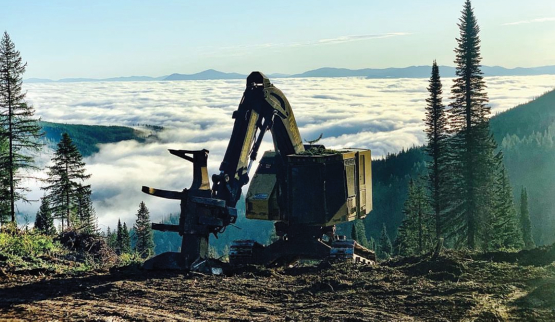
Justin Everhart calls himself a ‘diehard Tigercat fan.’ Above is the company’s Tigercat 830E feller buncher. JEM Forestry also has a Tigercat LS855E shovel logger with a felling head.


0 Comments