

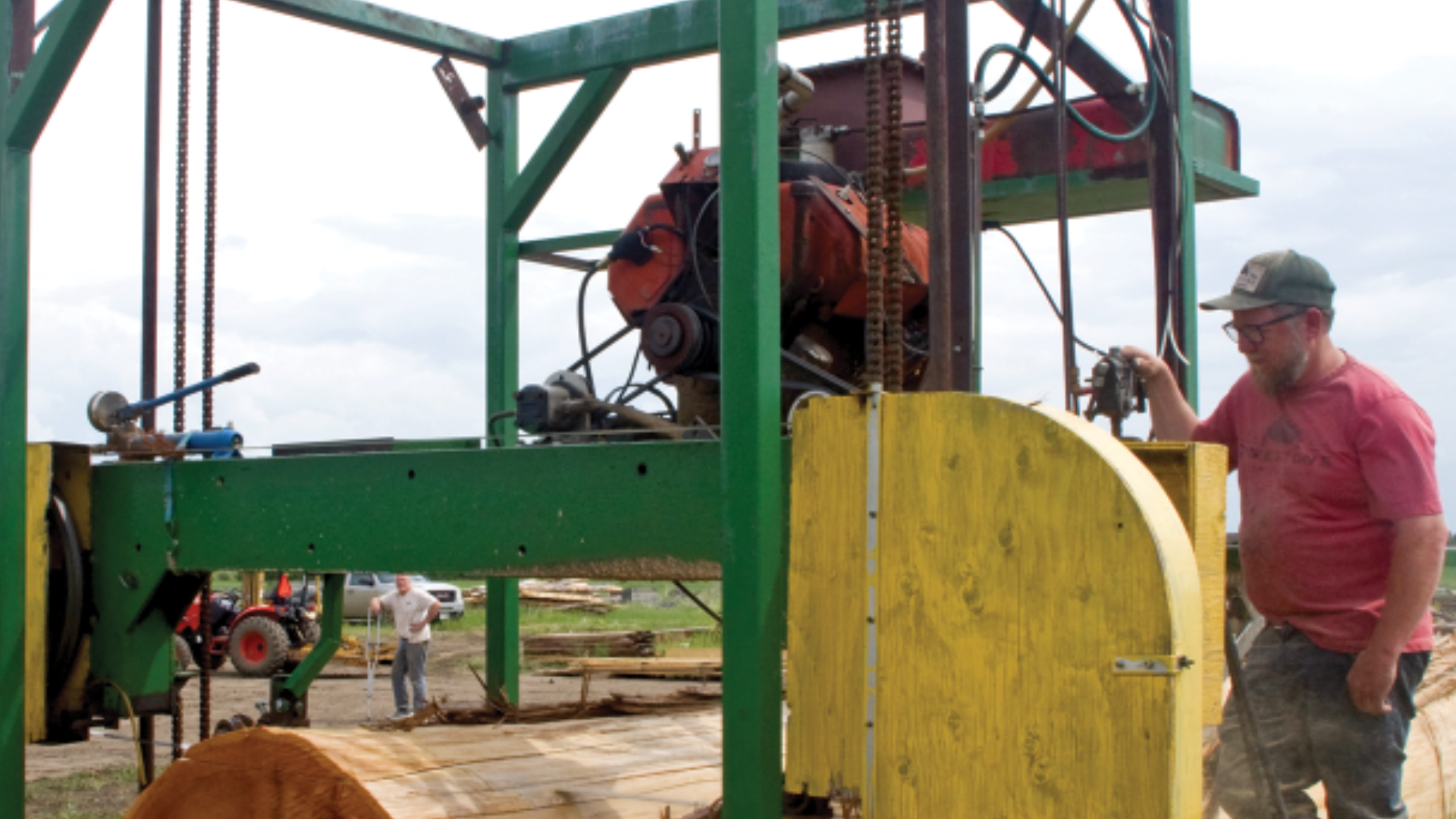
Faced with life and death five years ago when diagnosed with a rare form of leukemia, 45-year-old Haley Cochrane spent a year in recovery, both in hospital and at home. He had plenty of time to think and what kept him occupied was a recurring desire to establish a sawmilling venture that took him back to his roots.
Medical science discovered a pill which he takes once a day to help him recover, and when he was able, he put his business plan into action: offering custom sawmilling services and marketing of live edge wood slabs drawn from a variety of species for a multitude of potential uses, from small pen cases to massive boardroom tabletops.
Cochrane’s company, Pipestone Timber, is located about an hour southwest of Edmonton near the town of Calmar. Cochrane is a one-man-show and he likes it that way, to minimize overhead costs so that he can pass the savings on to his customers.
Launching this business was a return to his youth working at the family sawmill in Listowel, Ontario, four hours northwest of Toronto, located in the Great Lakes-St. Lawrence Forest. The region is dominated by a wide variety of valuable hardwood species like hard and soft maple, black walnut, white oak, and cherry as well as the iconic white pine and hemlock.
Pipestone Timber produces various widths and lengths of 2” thick live edge slabs for bigger projects, as well as charcuterie live edge boards measuring 1.25” thick, 6” to 10” wide, and 8’ long for smaller projects. Both types of lumber feature a high degree of character in the internal grain structure, which creates their value. Typically, the logs Cochrane sources are either too large for standard sawmills to break down or too distressed to have any value as lumber. If he doesn’t rescue them, they often end up in landfills.
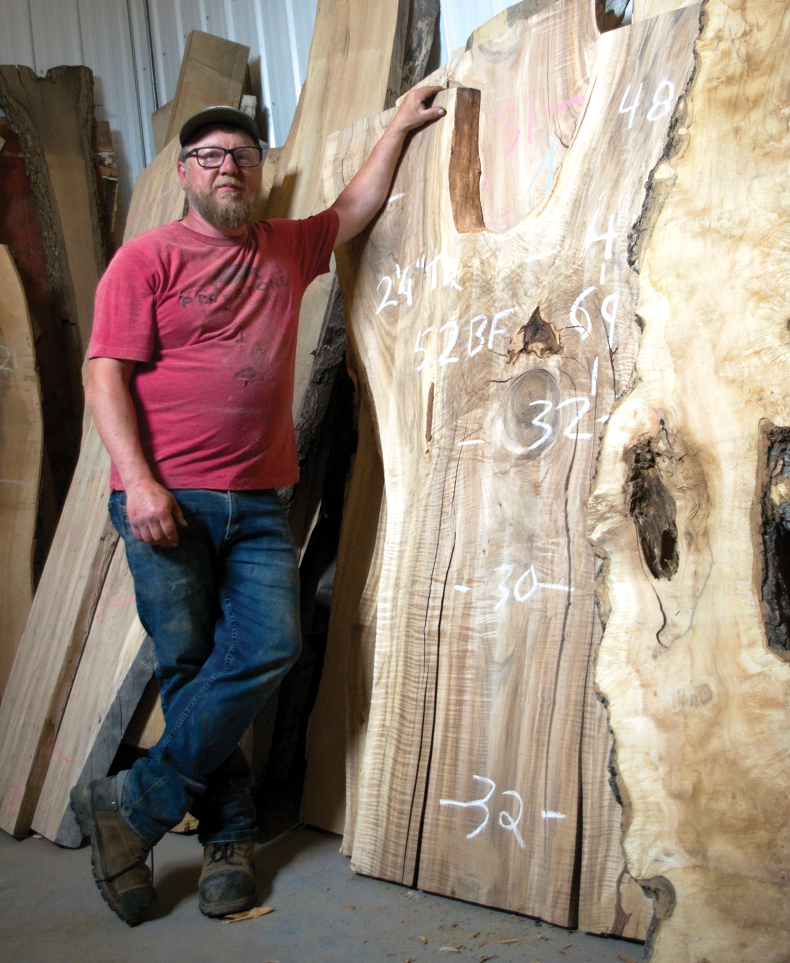
Pipestone Timber owner Haley Cochrane in the company’s showroom, a cabinetmaker’s dream, featuring everything from Manitoba maple to Black walnut.
About 90 per cent of Cochrane’s business is supplying partially finished live edge slabs while 10 per cent is custom sawmilling.
As mentioned, one feature that his lumber pieces have in abundance is character and that translates into high potential value if you have the vision to capture it, and the ability to market it to the right customers. Cochrane has both.
It’s said that beauty is in the eye of the beholder and that is entirely true when it comes to the partially finished live edge slabs in the Pipestone Timber showroom that Cochrane markets through direct and repeat customer contact as well as social media.
“For example, with Manitoba maple, you want all the burl that you can find in it,” says Cochrane. “You picture what the boards are going to look like and you want them to be as close to a rectangle as you can because someone is going to try to make a table out of it. But the pieces with the wild shapes, they get milled and turned into all sorts of products. There’s a project for every piece, and the more unique, the better, because that’s what my customers want.”
Customers range from individual artists to furniture manufacturers with several employees—and what is standard in all cases is that everything they make is one-of-a-kind because the slabs provided by Pipestone Timber are one-of-a-kind, and find some interesting homes.
“Connor McDavid’s wife, Lauren, sits at a desk that I milled the lumber for,” says Cochrane.
Among the most unique items Cochrane has supplied is the milled support and planed altar table used by the recently departed Pope Francis when he held mass at the Sacred Heart Church in Edmonton during his First Nations Reconciliation visit in 2022 (see sidebar story on page 22).
Pipestone Timber sources, mills, dries and CNC planes wood slabs primarily from locally grown Manitoba maple, ash, and even willow, as well as valuable species acquired from near his hometown in Ontario, those being primarily maple, oak, and walnut sourced within an hour’s drive from the family farm. He also mills a few other specialty hardwood species based on the specific needs of his customers. Recently, he has begun to dabble in softwood, having acquired a massive Western red cedar log from the Valemount, B.C. area.
Cochrane’s foray into marketing milled live edge wood slabs goes further than applying for a business license and opening a social media account.
As an experienced millwright, he designed and built both his large bandsaw mill and medium-size bandsaw mill from scratch. His large bandsaw mill was designed during the year he spent in recovery, but other equipment like his medium-size bandsaw mill and a dry kiln were designed and built over several years and spread out over three locations.
The large bandsaw mill uses a 2” wide and 25’ long blade and can break down logs measuring up to 74” across, 80” high, and 23’ long. It is used to essentially create large slabs, while the medium-size mill is designed for higher production, having been equipped with many hydraulic features for log manipulation on the carriage.
“I’ve been around mills my whole life so I have a really good idea of what components are needed,” Cochrane says. “Each mill you build is built for a purpose. Most of the components on the sawmills, I’ve made myself. I have a lathe and a milling machine. I can weld and fabricate.”
Once Pipestone Timber was established, all his existing equipment was relocated and his new large bandsaw mill as well as a new, large, custom-built, dry kiln were situated in one place at the company’s current location south of Calmar. The only off-the-shelf equipment Cochrane owns is an Avid-brand CNC planer machine able to handle 6’ x 12’ dried slabs. Both of his custom-made dry kilns are equipped with all the necessary electronics needed through the efforts of a former partner who was an electrician. The goal is to dry his slabs through several cycles of both air and mechanical drying down to between 7.5 to 8 per cent moisture content for stability.
The actor Orson Welles once famously stated in a television commercial that, “we will sell no wine before its time.” Cochrane has adopted a similar mantra in that he will sell no slab before its time. Typically, it will take over three years for a log he or his father have sourced to be fully harvested, milled, dried and planed before the slabs are offered for sale.
His father, Steve Cochrane, started Haley’s journey into sourcing, milling, and marketing high value wood slabs when he built a custom bandsaw mill from scratch and began marketing lumber and offering custom sawmilling from the family farm near Listowel. He also designed and built custom-made sawmills. As a teenager, Haley learned the ropes from that operation and then followed his father into the millwright trade. Both he and his brother, also a millwright, relocated about 15 years ago to Alberta, having heard the call of the oilpatch like so many others across Canada.
But at that same time, they always kept their hands in building sawmills while sourcing, milling, drying and marketing various log species locally and from Ontario as a hobby between rotational work shifts.
Then came that pivotal diagnosis five years ago and the decision by Haley to return to his roots on a full time basis.
Pipestone Timber is uniquely well-connected given Cochrane’s location south of Edmonton while still maintaining close family ties with the farm back in Ontario. The vast majority of logs he sources are salvaged from professional arborists working in that area or local landowners wanting to dispose of a tree taken down on their property. They negotiate a price for the log and, in most cases, taking charge of the tree is doing the companies and landowners a service.
Typically, Cochrane takes a trip to the family farm in Ontario once a year to inspect and select trees he and his father have sourced, with the intention of shipping partially finished slabs back home in Alberta for further value adding.
“Having this connection is super valuable,” says Cochrane. “Without having someone that I trust back east that knows the industry, it’s very, very hard to source material when you are not there looking at it directly. I don’t typically source my logs through conventional paths.”
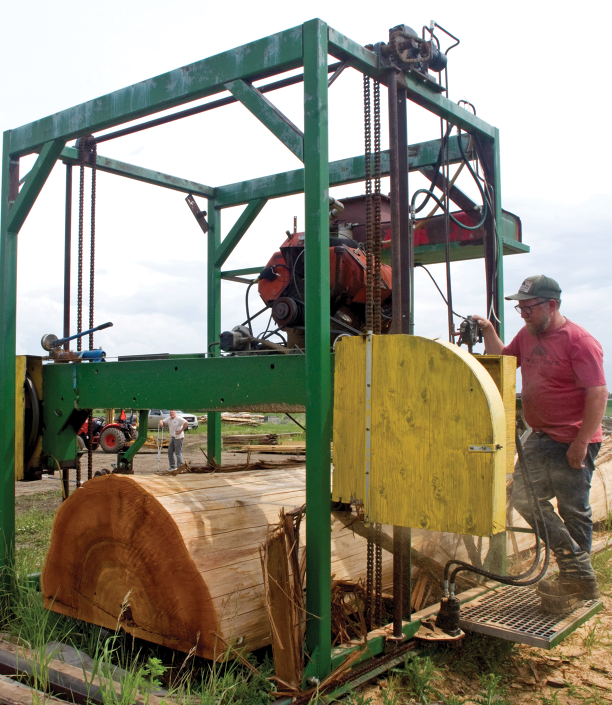
Haley Cochrane breaking down a Western Red Cedar log, acquired from Valemount, B.C., on his custom-built bandsaw.
Initially, when he opened the business, he shipped full-size logs to Alberta, but that proved cost prohibitive. So given that his father could still operate his bandsaw mill on the farm, has the equipment to retrieve available logs and the fact that he is now retired, he is able to mill the logs into raw slabs and then Cochrane ships them to Alberta in one big load each winter, making the cost much more affordable. They are not shipped immediately after milling, but spend some time air drying on stickered stacks on the farm.
When the air-dried raw slabs arrive in Alberta, this is when the value-adding process begins in earnest, with Cochrane evaluating each slab for characteristics and going through several air and mechanical drying steps to acclimatize the slabs to Alberta’s drier climate.
“Once the slabs arrive in Alberta, I mill them, stack them in the yard on sticks so they air dry, and then forget about them for between a year-and-a-half to two years,” says Cochrane. “I’ve got a cycle going.”
After long term air drying, the slabs are placed in a dry kiln for a final drying cycle and then they are CNC planed for market. Cochrane says that having the ability to plane the slabs to about a 2” thickness makes them much more marketable, but even then, he holds onto them for about three weeks to absolutely ensure that they are stable.
At that point, he measures the dimensions of the slabs and posts the particulars to potential customers on his social media sites. Often, he already has a customer for a slab based on his regular contact with customers.
It took a while to establish a proper cycle to deliver unique and top quality slabs to his growing customer base. But like a great wine, Cochrane knows that producing quality takes time.
Pipestone Timber helps rescue exotic hardwood for Pope’s altar
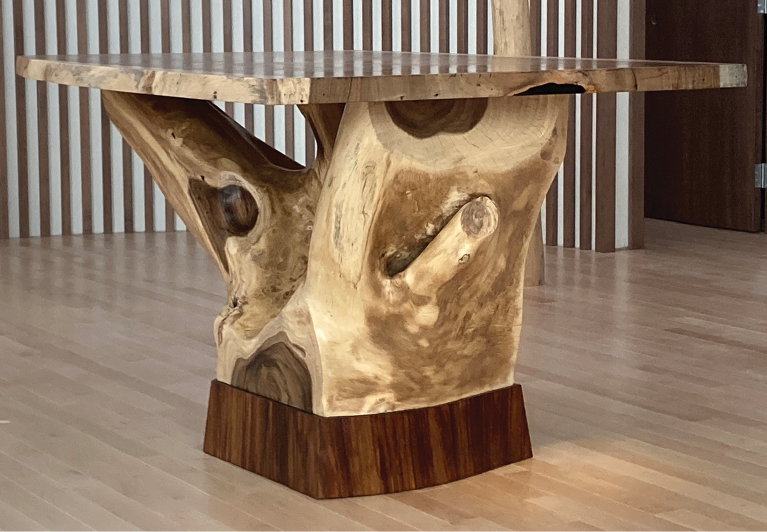
Leukemia survivor Haley Cochrane, of Pipestone Timber, landed the job of secretly milling the altar stand and tabletop for a fire-damaged church for use on the occasion of Pope Francis’s historic reconciliation visit to Alberta in 2022.
The purpose of the visit was to promote healing, starting by rebuilding the church altar after a fire at the prominent First Nations Sacred Heart Church in downtown Edmonton, and then providing the platform for the Pope to formally apologize to Canada’s First Nations for the church’s residential school policy that forcibly removed children from their families.
Was Cochrane’s survival through what he describes as a miracle drug developed by medical science and then his fundamental participation in the creation of that new altar for this historically significant event divine providence or just pure luck? You be the judge.
However, that is exactly what happened when the church acquired a wild piece of exotic Parota hardwood that it wanted to use to rebuild the altar for the Pope’s visit.
“The wood was so twisted that it was almost unworkable,” says Jim Playfair, cabinetmaker and co-owner of Edmonton-based, Harmony in Wood, which won the contract for the project. “The interesting thing was that when we got the contract, we thought that it was just another altar for a church. We only learned later that it was specifically for the Pope’s visit.”
Pipestone Timber, owned by Cochrane, was recommended to Playfair to mill the Parota stump so that its many branches would not only support the altar tabletop but keep it level. Cochrane was able to parlay his extensive industry experience and large, custom-made bandsaw mill located near Calmar, Alberta, to do the job, and thus began a lasting business relationship between Cochrane and Playfair that continues to this day. Cochrane has become his go-to custom sawyer and CNC planer provider.
“The work we do is really a community of custom woodworkers helping each other,” says Playfair. “It’s become invaluable to us to have Haley as a resource. I know that I am not wasting my time coming out here. So much of our work is not what you know, but who you know.”
Playfair describes the raw tabletop as heavy and 3.25” thick. Cochrane was able to CNC plane the tabletop down to 2” in addition to providing a level support.
Both Playfair and Cochrane are simpatico souls when it comes to the value of wood.
“We’re working with something that Nature made,” Playfair says. “So each piece is unique. It’s beautiful, and if you do it right, the wood products we make can last for centuries.”
And that is exactly what the parishioners of Sacred Heart Parish are hoping for—a symbol of Nature’s remarkable inward beauty which is so much a part of their cultural heritage as they continue their journey of healing.


0 Comments