

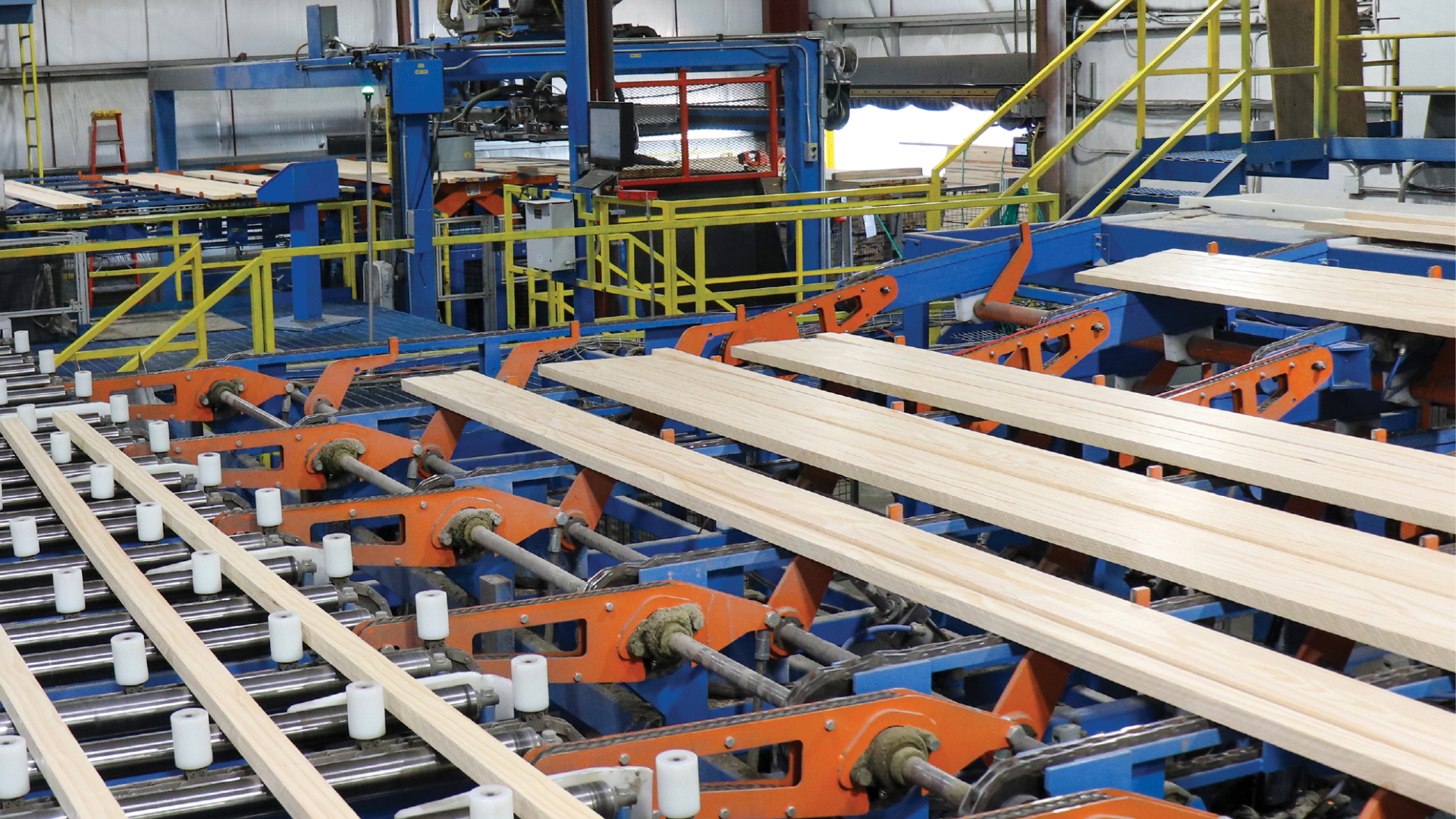
MADRAS, Oregon – Bright Wood has benefitted in recent years from upgrading its scanners at four plants for cut operations with USNR technology and its latest AI (artificial intelligence) assisted scanners. The company has seven of the USNR scanners in operation and also has an eighth that will be installed in the future.
Bright Wood is the largest independent manufacturer of window and patio door components and engineered dimensional lumber in the U.S. Based in Madras, Oregon, it employs more than 1,000 people in 28 processing plants at five locations. Bright Wood has facilities in Madras, Redmond, Prineville, and Culver, Oregon, and Menomonie, Wisconsin. In addition to window and door components and engineered dimension lumber, the company’s operations produce mouldings, millwork, and cut stock.
Replacing old scanners and upgrading to USNR AddVantage scanners in recent years has paid dividends for Bright Wood. In late 2024, for example, the company set a record of over 5.4 million lineal feet scanned by the USNR systems.
Outdated scanning systems can slow processing time and also result in misallocated manpower and excess waste, costing a mill thousands of dollars annually. Those reasons are why Bright Wood searched for alternative scanner options and ultimately led them to the USNR AddVantage scanner system. The AddVantage uses AI technology that provides industry-leading detection and classification of defects.
The key to the AddVantage scanners’ success is deep learning artificial intelligence. The Bright Wood optimization team investigates how the scanners can be better at identifying both high-grade wood and defects. Then they work offline to manually ‘train’ the USNR scanners to identify the issues causing downstream waste and rework. Thanks to this systematic approach, the capabilities of the scanners are continually improving, even identifying defects within defects.
Bright Wood was ready to expand, but their equipment was limited. Outdated machines made it impossible to scan their product at the rates they needed to reach the goals they wanted to achieve. At the forefront of this issue was the scanning systems.
The USNR AddVantage fit the bill. Keenan Stovall, Bright Wood’s director of optimization, said the care and dedication of USNR personnel clinched the decision for the company. From providing round-the-clock support, following up on software adjustments, and offering hands-on training for operators, it was the USNR commitment to strong customer service that led Stovall and his team to select the AddVantage technology.
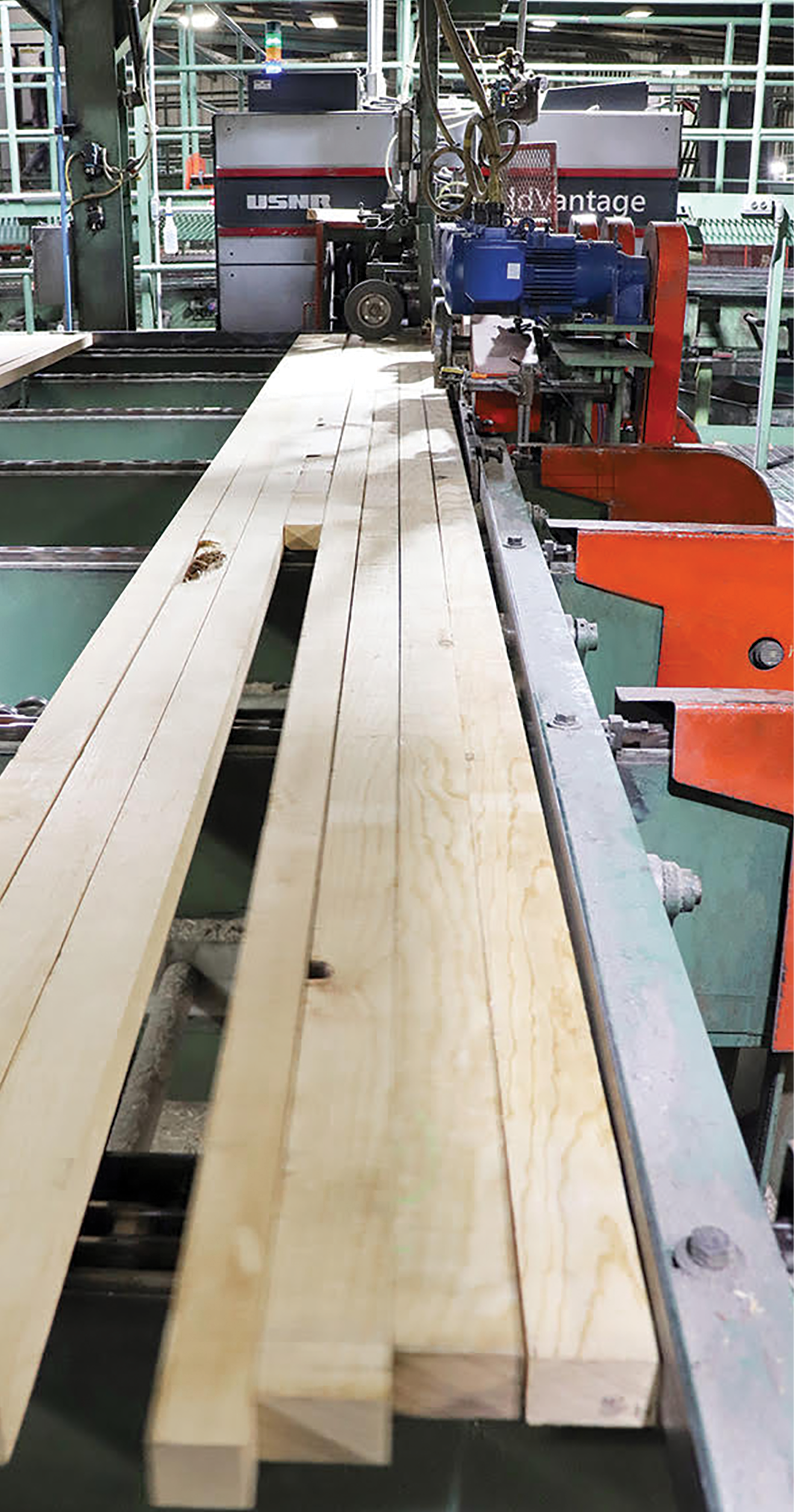
Bright Wood has seven USNR AddVantage scanners in operation and will install an eighth in the future. The USNR systems use artificial intelligence.
USNR staff “want to work with us,” he said. “We talk every week…We didn’t want to feel like we were on an island. We didn’t want to feel like we couldn’t have engagement and improvement.”
Bright Wood installed its first USNR AddVantage scanner at its Prineville cut plant in 2020. The new scanner was able to detect more types of wood characteristics and with greater accuracy. The old scanner could detect 12 types of defects; the USNR AddVantage scanner could identify and differentiate between 21 types.
Building on the success at the Pineville plant, Bright Wood replaced the scanner on a production line at Madras Plant 1 in 2021 with another USNR AddVantage scanner. It added a new line to Madras Plant 1 with another USNR AddVantage scanner in 2022, and the same year it also replaced three scanners in its original optimization plant, built in 1991, with the new USNR AddVantage scanners.
At Madras Plant 1, “We were at a point where we knew we needed to do more scanning and optimizing,” said Stovall. “That’s what we do, we break down wood and we wanted to be really good at…We did feel like we had maxed out our current scanners and we couldn’t really get any more out of them…”
By USNR’s second and third visits to the plant to make adjustments, Bright Wood already was experiencing significant gains. Even during test runs, the new AddVantage scanners were breaking processing records. And, according to Stovall, the system was substantially better at spotting fixable issues rather than outright rejecting a flawed board.
“One of the things that was happening in our old system is we would have a board that would have a solution error or no solution, it would go all the way to the saw, it would stop, and then the saw operator would have to stop production, pull that piece out, drop it off somewhere, and it would have to be cut manually. This new system just doesn’t have that problem.”
The former manual rip and cut operation is now a first-of-its-kind optimizing cut plant. Each of the plant’s two production lines consists of a USNR AddVantage scanner feeding two high-speed Ultimizer cut-off saws.
Workers can use their time more productively. No need to spend hours sifting through “rejected” boards or waste thousands on product that could have been saved.
With new technology comes new opportunity. Bright Wood expanded its product offering into dimensional products.
The USNR AddVantage chop saw optimizer is designed to integrate an optimized chop saw line for the rough mill in the secondary, or reman industry. Equally capable of processing hardwoods and softwoods, AddVantage replaces marking by crayons, offering full optimization of fixed and random lengths to increase value with higher precision measuring and grading.
AddVantage can optimize single or multiple saw lines, scanning wood at speeds well over 600 feet per minute using multiple technologies for precise measurement and detection of natural and manufacturing defects. AddVantage determines the cuts that will result in the highest value recovery.
AddVantage uses four-sided, multi-spectral vision, infrared, laser, and geometric profiles to identify and classify a wide range of characteristics. Deep learning artificial intelligence is even capable of recognizing defects within defects, significantly boosting solution accuracy. AddVantage currently detects over 15-plus types of visual and geometric defects, and growing.
Benefits include:
– dramatically faster startups
– easy to fine-tune by adjusting the sensitivity settings
– new species or defects can easily be added
– reduces labor and raw materials
– increases recovery
Andersen Windows placed Bright Wood’s very first order in 1960, shortly after the business started in Madras. Two of the three Bright Wood founders loaded a Volkswagen van with ponderosa pine cut stock and drove to the Midwest to see if they could sell to the large window and door manufacturers. Times were so tight that Carl Peterson and Ken Stovall slept in the van and ate mostly cheese and crackers.
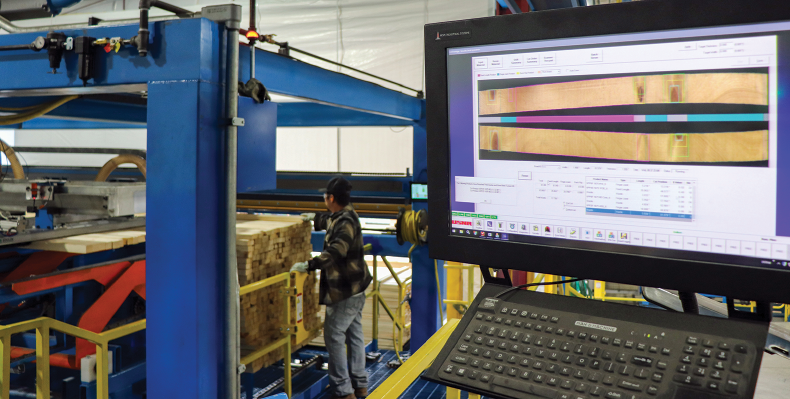
Automated vacuum loader begins the process at Bright Wood’s Madras Plant 1 by feeding a unit of ripped material onto a conveyor that delivers the boards to the USNR scanner.
Sixty-six years later, Andersen — and many other premium window and door manufacturers in the U.S. — still buy their wood components from Bright Wood.
Andersen Corporation purchased Bright Wood from the Stovall family in February of this year. Bright Wood continues to operate as an independent business serving the needs of its broad customer base.
“Andersen is grateful to the founding Stovall family for their generations of leadership and transformative contributions to the industry,” said Chris Galvin, chairman and CEO of Andersen Corporation. “Our investment in Bright Wood aims to ensure the company remains a valued supply partner to the fenestration industry for years to come.”
“It has been our honor and privilege to own and operate Bright Wood Corporation for the past 65 years,” said Kevin and Dallas Stovall in a joint statement. “We are grateful to the dedicated members of our team and business partners who enabled our success and the trust of our valued customers who inspired our innovation and made us the industry leader.”
“Andersen shares our values of integrity, quality and shared success, and we look forward to watching Bright Wood continue to thrive under its new leadership.”
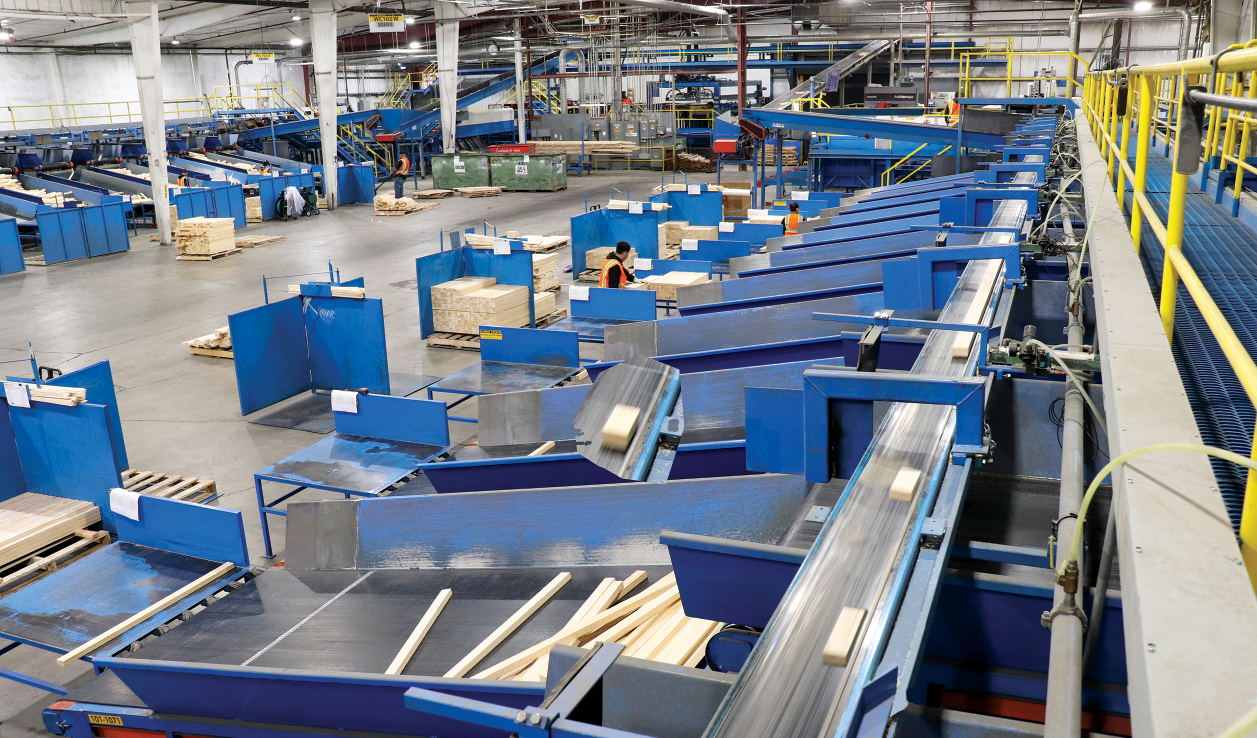
Each piece of cut stock is automatically delivered to the grading station assigned to that specific length. Graders verify the cut stock is on grade. Much of the material is used in premium-grade window and door components.
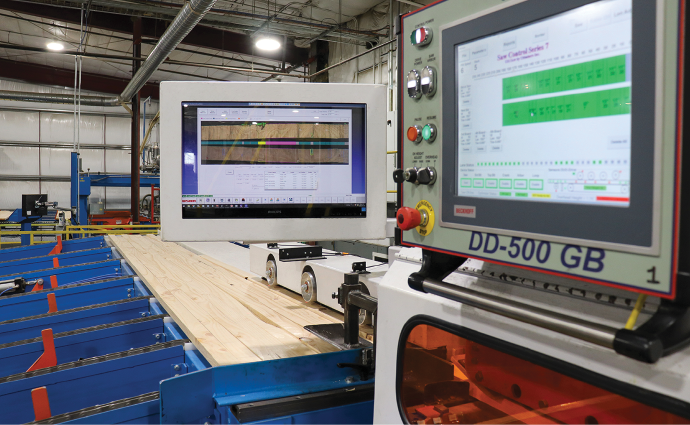
Infeed to one of the line’s two Ultimizer saws.






0 Comments